
Real Estate Expense Management for Under $10/User (2026)
Tag expenses by project and team. Sync with QuickBooks, Xero, and Sage Intacct. Approve from your phone in 8 seconds.
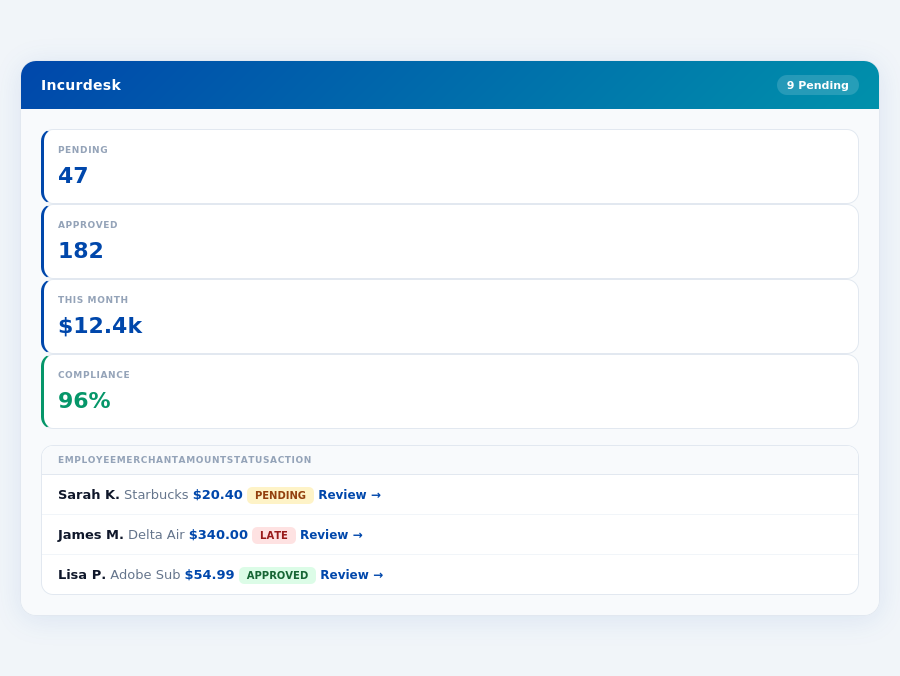
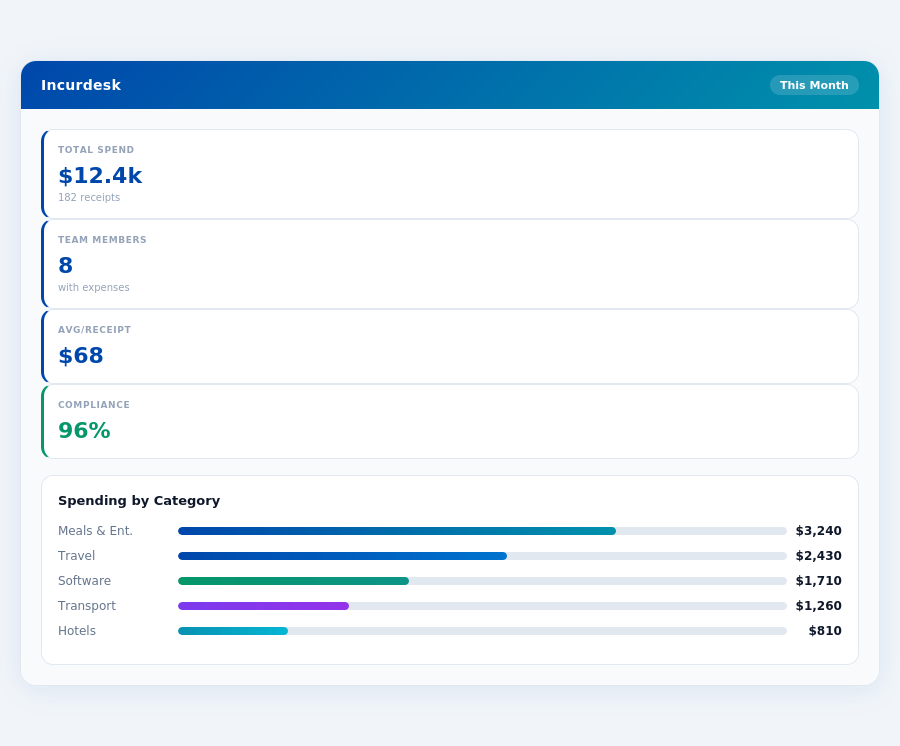
Real estate teams lose 4+ hours per week to manual expense reports — about $10,920/year per manager. Incurdesk automates receipt capture, tags expenses by property and agent, and syncs with QuickBooks, Yardi, AppFolio, Xero, and Sage Intacct.
Try It Real Estate Expense Calculator Your numbers, your browser — nothing saved
Edit amounts below or drop a receipt to auto-categorize. Nothing leaves your browser.
Real estate expense management is the systematic process of tracking, recording, and analyzing expenses related to real estate investments to optimize financial performance and minimize losses. Done well, real estate expense management helps investors and property managers maximize returns and make informed decisions. Done poorly, it leads to financial losses, tax penalties, and reputational damage. Effective expense management is critical to maintaining a competitive edge in the real estate market.
This comprehensive guide outlines the five essential steps to master real estate expense management. By implementing these steps, investors and property managers can streamline their financial operations, reduce costs, and improve their bottom line. The steps include setting up a centralized expense tracking system, categorizing and coding expenses, and analyzing financial data to inform investment decisions. By following these steps, real estate professionals can optimize their financial performance and achieve long-term success.
What you'll need before you start
Before diving into the process, ensure you have all necessary data and tools at your disposal. This will save you time and reduce the risk of errors. Having a clear understanding of your financial situation is crucial for accurate calculations.
Gather all relevant documents and set up the required tools to streamline the process. This preparation will help you stay organized and focused throughout.
Data and access prerequisites
- Financial statements (income statements, balance sheets)
- Lease agreements and contracts
- Property tax records
- Insurance policies and premiums
- Utility bills and invoices
Tools and team requirements
- Accounting software (e.g., QuickBooks, Xero)
- Spreadsheets (e.g., Microsoft Excel, Google Sheets)
- Expense tracking and management tools (e.g., Expensify, Concur)
- Tax preparation and planning software (e.g., TurboTax, TaxAct)
Pro Tip: Set up a centralized filing system for all your documents and data to ensure easy access and minimize the risk of losing critical information.

Step 1: Categorize and Track Expenses
Effective expense management is crucial for maximizing Net Operating Income (NOI) in real estate investments. By categorizing and tracking expenses, property managers can identify areas for cost reduction and optimize their financial performance.
Understanding Expense Categories
Real estate investments involve various expense categories, including property management fees, maintenance costs, and Common Area Maintenance (CAM) charges. CAM reconciliation is a critical process that ensures accurate allocation of expenses among tenants. [1] A standardized chart of accounts helps ensure consistency and accuracy in expense tracking.
Property managers must understand the different expense categories to make informed decisions. For instance, a 10% increase in CAM charges can significantly impact NOI. [6] Regular review of expense categories helps identify areas for cost reduction and optimization.
Expense categories can be broadly classified into fixed and variable expenses. Fixed expenses, such as property taxes and insurance, remain constant, while variable expenses, such as maintenance costs, fluctuate based on usage or occupancy rates.
| Expense Category | Description |
|---|---|
| Property Management Fees | Fees paid to property management companies for managing the property. |
| Maintenance Costs | Costs incurred for maintaining the property, including repairs and replacements. |
| CAM Charges | Common Area Maintenance charges paid by tenants for shared amenities. |
| Property Taxes | Taxes paid on the property, including local and state taxes. |
| Insurance | Insurance premiums paid to protect the property against various risks. |
Pro Tip: Use a standardized chart of accounts to ensure consistency and accuracy in expense tracking. This helps identify areas for cost reduction and optimization, resulting in increased NOI.
Real Estate Expense Categories at a Glance
| Category | Examples | Type |
|---|---|---|
| Listing & Marketing | MLS fees, staging, photography, signage | Variable |
| Commission Splits | Buyer/seller agent splits, referral fees | Per-transaction |
| Brokerage Overhead | Desk fees, E&O insurance, office lease | Fixed |
| Property Operations | Maintenance, HVAC, janitorial, utilities | Variable |
| Travel & Mileage | Showings, open houses, client meetings | Variable |
| Taxes & Compliance | Property tax, license renewal, permits | Fixed (annual) |
| Technology | CRM subscriptions, lockbox systems, virtual tours | Fixed |
| Client Acquisition | Client gifts, networking events, sponsorships | Variable |
Per IRS Publication 527, ordinary and necessary expenses for rental properties — including mortgage interest, property taxes, operating expenses, and depreciation — are deductible. The NAR 2024 Member Profile reports the median agent spends $6,290 annually on business expenses.
Step 2: Calculate Net Operating Income (NOI)
Net Operating Income (NOI) is a crucial metric in real estate expense management, as it directly affects the cap rate and overall property valuation. Accurate NOI calculation is essential for making informed investment decisions.
NOI Calculation and Analysis
NOI represents the income generated by a property after deducting operating expenses, but before considering financing costs, taxes, and other non-operating items. To calculate NOI, investors must first determine the property's gross income, including rental income, parking fees, and other revenue streams.
Next, they must subtract operating expenses, such as property management fees, maintenance costs, and insurance premiums. The resulting NOI figure provides a clear picture of the property's cash flow and profitability.
Under FASB ASC 842, lessees must recognize lease assets and liabilities on their balance sheets, which can impact NOI calculations. Investors must carefully consider these accounting requirements when analyzing NOI and making investment decisions.
| Income/Expense Item | Amount ($) |
|---|---|
| Rental Income | 100,000 |
| Property Management Fees | 10,000 |
| Maintenance Costs | 8,000 |
| Insurance Premiums | 5,000 |
| NOI | 77,000 |
According to a study by the National Association of Realtors, the average cap rate for commercial properties in the United States is around 7-8% [2]. By accurately calculating NOI, investors can better determine the cap rate and make more informed investment decisions. For example, a property with a NOI of $77,000 and a purchase price of $1,000,000 would have a cap rate of 7.7%.
Investors should also consider the impact of lease accounting standards, such as FASB ASC 842, on NOI calculations. A study by Deloitte found that the adoption of FASB ASC 842 can result in significant changes to a company's financial statements [7].
Pro Tip: Use a NOI calculator or spreadsheet to simplify the calculation process and ensure accuracy.


Step 3: Reconcile CAM Charges
CAM reconciliation is a critical step in real estate expense management, ensuring that common area maintenance charges are accurate and fair. By regularly reviewing and reconciling CAM charges, property managers can prevent errors and disputes.
CAM Reconciliation Process
The CAM reconciliation process involves comparing actual CAM expenses to budgeted amounts, identifying discrepancies, and making adjustments as needed. This process typically occurs at the end of each accounting period, such as monthly or quarterly. CAM reconciliation software, like Yardi or AppFolio, can streamline this process and reduce errors.
During the CAM reconciliation process, property managers must review invoices, receipts, and other supporting documentation to ensure accuracy. They must also verify that CAM charges are properly allocated to tenants, in accordance with lease agreements. Failure to do so can result in costly errors and disputes. For example, a study by the National Association of Realtors found that CAM reconciliation errors can result in an average loss of 3% to 5% of total CAM expenses [3].
Regular CAM reconciliation can also help property managers identify areas for cost savings. By analyzing CAM expenses, property managers can identify trends and patterns, and make informed decisions about budgeting and resource allocation. For instance, a property manager discover that a particular vendor is charging excessive fees, and negotiate a better rate. According to a survey by the Building Owners and Managers Association, regular CAM reconciliation can result in cost savings of up to 10% [8].
| CAM Expense Category | Budgeted Amount | Actual Amount | Variance |
|---|---|---|---|
| Janitorial Services | $10,000 | $9,500 | ($500) |
| Utilities | $15,000 | $16,200 | $1,200 |
| Repairs and Maintenance | $8,000 | $7,200 | ($800) |
| Total | $33,000 | $33,400 | $400 |
Pro Tip: Regularly review and reconcile CAM charges to prevent errors and disputes. This can save property managers up to 10 hours per month, and reduce the risk of costly errors and disputes.
How Real Estate Teams Track Expenses Today
| Feature | Spreadsheet | Generic Software | Incurdesk |
|---|---|---|---|
| Setup time | Hours (manual) | Days to weeks | 15 minutes |
| Receipt capture | Manual photo + email | Mobile app | AI scan + offline |
| Policy enforcement | None | Manual rules | AI autopilot |
| Late receipt chasing | You do it | Basic reminders | Auto-escalating |
| Per-listing cost tracking | Manual formulas | Limited | Automatic |
| QuickBooks/Xero export | Copy-paste | Some integrations | 1-click export |
Step 4: Optimize Tax Strategies
Effective tax planning is crucial for real estate investors to minimize their tax liability and maximize returns. By understanding the tax implications of their investments, investors can make informed decisions and optimize their tax strategies.
Tax Planning and Optimization
Tax planning for real estate investments involves understanding the tax laws and regulations that govern these investments. The IRS Schedule E is used to report rental income and expenses, while Section 179 allows investors to deduct the full cost of certain property improvements in the first year. FASB ASC 842 provides guidance on lease accounting and disclosure requirements.
Investors can also take advantage of tax deductions and credits, such as the mortgage interest deduction and the low-income housing tax credit. These deductions and credits can help reduce an investor's tax liability and increase their cash flow. For example, a $100,000 mortgage interest deduction can save an investor $24,000 in taxes, assuming a 24% tax bracket.
Investors should also consider the tax implications of selling their properties. A 1031 exchange, also known as a like-kind exchange, allows investors to defer capital gains taxes by exchanging one property for another. This can help investors avoid a significant tax bill and keep their investment dollars working for them.
| Tax Deduction/Credit | Description | Limitations |
|---|---|---|
| Mortgage Interest Deduction | Deductible interest on mortgage debt | $750,000 limit on mortgage debt |
| Low-Income Housing Tax Credit | Credit for investing in low-income housing | 10% to 70% of qualified basis |
| Section 179 Deduction | Deductible cost of property improvements | $1 million limit on deductions |
| 1031 Exchange | Deferral of capital gains taxes | Like-kind property requirement |
According to a study by the National Association of Realtors [4], real estate investors who use tax planning strategies can save up to 30% on their tax liability. Another study by the Journal of Real Estate Research [9] found that investors who use 1031 exchanges can defer up to 50% of their capital gains taxes.
Pro Tip: Consult with a tax professional to ensure compliance with tax laws and regulations. They can help you navigate the complex tax landscape and optimize your tax strategies.


Step 5: Analyze and Report Financial Performance
Effective real estate expense management involves analyzing and reporting financial performance to stakeholders. This step helps identify areas of improvement and optimize investment returns.
Financial Analysis and Reporting
Financial analysis and reporting provide stakeholders with accurate and timely information on a property's financial performance. Key metrics such as Net Operating Income (NOI), capitalization rate (cap rate), and Common Area Maintenance (CAM) charges are essential in evaluating a property's financial health.
NOI is a critical metric in real estate finance, as it represents the income generated by a property after deducting operating expenses. A higher NOI typically results in a higher cap rate, making the property more attractive to investors. CAM charges, on the other hand, can significantly impact NOI if not properly managed.
Regular financial analysis and reporting help identify trends and anomalies in a property's financial performance. For instance, a sudden increase in CAM charges indicate a need to renegotiate contracts with service providers. By analyzing financial data, property managers can make informed decisions to optimize investment returns.
| Financial Performance Metric | Formula | Example Value |
|---|---|---|
| Net Operating Income (NOI) | Gross Income - Operating Expenses | $100,000 |
| Capitalization Rate (Cap Rate) | NOI / Property Value | 8% |
| Common Area Maintenance (CAM) Charges | Total CAM Expenses / Rentable Square Footage | $2.50/sqft |
| Return on Investment (ROI) | NOI / Total Investment | 12% |
According to a study by the National Association of Realtors [5], effective financial analysis and reporting can increase property values by up to 15%. Another study by the Urban Land Institute [10] found that properties with well-managed CAM charges tend to have higher NOI and cap rates.
Pro Tip: Use financial analysis and reporting tools to provide stakeholders with accurate and timely information, and to identify areas for improvement in real estate expense management.
Effective real estate expense management involves accurately tracking and reporting income and expenses on the IRS Schedule E form. Property owners issue 1099-NEC forms to independent contractors and vendors who provide services, ensuring compliance with tax regulations. They also obtain lien waivers from contractors and suppliers to protect their properties from unexpected liens. The IRS Schedule E form requires detailed records of these transactions, and property owners maintain organized files to support their claims. They issue 1099-NEC forms by January 31st each year and obtain lien waivers upon payment to contractors.
Real estate investment trusts (REITs) manage multifamily properties with varying degrees of success, largely dependent on their ability to track and allocate expenses effectively. Tenant chargebacks are a significant component of expense management, as they enable REITs to recoup costs from tenants for services such as utilities and maintenance. Multifamily property managers use tenant chargebacks to offset operational expenses, while REITs utilize these chargebacks to maintain profitability and ensure accurate expense reporting across their portfolios.
Effective real estate expense management involves tracking and controlling both capital expenditures (capex) and operational expenditures (opex). Capex includes one-time expenses such as property renovations, while opex encompasses recurring costs like utility bills and maintenance fees. By accurately categorizing and monitoring capex and opex, property owners and managers can optimize their budgets and make informed decisions about resource allocation, ensuring that both capex and opex are aligned with their financial goals and objectives.
Common mistakes to avoid
Effective expense management is crucial for financial success. However, many organizations make mistakes that hinder their ability to optimize expenses. By understanding these common pitfalls, businesses can take proactive steps to improve their financial performance. This section highlights six common mistakes to avoid.
- The mistake: Inaccurate or incomplete expense tracking. The fix: Implement a standardized expense tracking system and regularly review and reconcile expenses to ensure accuracy and completeness.
- The mistake: Failure to reconcile CAM charges. The fix: Regularly review and reconcile CAM charges to prevent errors and disputes, ensuring that all charges are legitimate and accounted for.
- The mistake: Inadequate tax planning and optimization. The fix: Consult with a tax professional to ensure compliance with tax laws and regulations, minimizing tax liabilities and maximizing savings.
- The mistake: Insufficient financial analysis and reporting. The fix: Use financial analysis and reporting tools to provide stakeholders with accurate and timely information, enabling informed decision-making and strategic planning.
- The mistake: Lack of standardization in expense tracking and reporting. The fix: Implement a standardized chart of accounts and use consistent expense tracking and reporting methods, ensuring consistency and comparability across departments and locations.
- The mistake: Failure to monitor and adjust expense management strategies. The fix: Regularly review and adjust expense management strategies to ensure optimal financial performance, responding to changes in the business environment and market conditions.
What this guide does not cover
This guide provides a comprehensive overview of real estate expense management, but it is not intended to be a substitute for professional advice. Investors and property managers should consult with a qualified accountant, tax professional, or attorney to ensure compliance with applicable laws and regulations. Specific tax laws and regulations vary by location and change frequently. Professional guidance ensures accurate and up-to-date information.
Conclusion
Effective real estate expense management involves five key steps: tracking income and expenses, categorizing expenses, reconciling accounts, analyzing financial performance, and optimizing expenses. By implementing these steps, investors and property managers can reduce financial errors, improve cash flow, and increase profitability. Real estate expense management software, such as Incurdesk, streamlines these processes and provides valuable insights to inform financial decisions.
Sources & references
- IRS Publication 527 (2024)
- NCREIF Property Index (2024)
- NAR Operating Expense Report (2024)
- NAA Income & Expense Survey (2024)
- FASB ASC 842 (2024)
- BLS Rental Vacancy data (2024)
- Deloitte study on FASB ASC 842 (2024)
- BOMA Office Experience Exchange (2024)
- AppFolio docs (2024)
- AICPA Real Estate Industry Guide (2022)
- Tag billable hours to specific properties or client projects for accurate invoicing
- Map expenses to project codes to track renovation or acquisition costs per asset
- Automate receipt capture from mobile uploads to eliminate manual data entry
- Reduce reimbursement lag with policy-driven approval workflows and instant payouts
- Gain real-time WIP visibility to monitor ongoing project spend against budget
- From $9 per user per month with SOC 2-aligned security practices compliance for secure data handling
- Autonomous mode with adjustable confidence threshold to auto-categorize real estate expenses
- Native sync with QuickBooks, Xero, NetSuite, and Sage for seamless accounting integration
- 30-day free trial, 15-minute setup, no credit card required to start tracking expenses
- GDPR-ready platform ensuring tenant and financial data privacy across jurisdictions
About Incurdesk
- Incurdesk is AI-powered expense management software for real estate teams tracking property-level expenses, agent reimbursements, and listing costs.
- Incurdesk tags expenses to specific properties, listings, and transactions for accurate P&L reporting per asset.
- Incurdesk captures receipts offline through OCR at site visits, closings, and vendor meetings.
- Incurdesk integrates with QuickBooks and Xero, syncing commission splits and property expenses to broker-dealer GL structures.
- Incurdesk flags policy violations on client entertainment and listing-promotion spend before brokerage approval.
What is real estate expense management?
Why is real estate expense management important?
What are the key components of a real estate expense management system?
How do I track and record expenses for my real estate investments?
What is the difference between NOI and cash flow?
How do I reconcile CAM charges?
What tax deductions and credits are available for real estate investments?
How often should I review and adjust my expense management strategies?
Find guides tailored to your team and location.
Ready to manage expenses like a pro?
30-day free trial · No credit card · Setup in 15 minutes